

Learning Hub
Dive into the possibilities of forestry, bioenergy, and negative emission hydrogen! The Learning Hub is your gateway to understanding the processes, science, and career paths driving these innovative industries.
Explore resources that break down complex topics, spotlight real-world applications, and connect you to opportunities shaping a sustainable future.
Value Chain
This value chain provides an overview of the bioenergy and negative-emission hydrogen lifecycle, from natural carbon capture in forests to the conversion of wood waste into clean fuels that deliver measurable climate benefits and long-term carbon reductions.

1. Trees grow and
capture carbon
Trees naturally pull carbon dioxide (CO₂) out of the air as they grow tall and strong.

2. Trees are harvested for woodproducts
Once mature, trees are harvested forvaluable products like lumber, leavingbehind unused branches and scraps.

OR
3. Leftover wood becomes waste
3. Wood waste
is collected
This leftover wood is often left to rot or burn, which releases the CO₂ back into the air.
Instead of letting it rot, wood waste canbe collected to help reduce wildfire riskand turn it into something useful.

4. Wood waste becomes wood pellets
Collected wood waste is compressed into small,powerful wood pellets that can be used as energy fuel.
Option 1: Bioenergy

5. Pellets are burned to
make bioenergy
Wood pellets are burned in specialized systems to create electricity, heat, or industrial power. Used for:
-
Heating buildings,
-
Industrial boilers,
-
Electricity generation (often inrural areas or microgrids)
OR
Option 2: Negative Emission Hydrogen

6a. Pellets go to a CCS
(Carbon Capture & Storage) plant
Wood pellets are burned in specialized systems to createelectricity, heat, or industrial power. Used for:
-
Heating buildings,
-
Industrial boilers,
-
Electricity generation (often inrural areas or microgrids)

6b. Gas is turned to liquid and separated
The gas is cooled and turned into liquid so that the hydrogen can be separated from the carbon.
6c. Carbon is stored underground
(Carbon Capture & Storage) plant
The carbon is locked away deep underground, where it can’t re-enter the atmosphere.

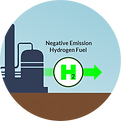
6d. Hydrogen becomes bright green energy
The hydrogen that remains is called “bright green hydrogen” — a super cleanenergy source with zero carbon. Used for:
-
Decarbonize industrial facilities
-
Blending in refining of low carbon fuels
-
Generating electricity
-
Heating homes and buildings
-
Powering electric vehicles (cars, trains, trucks)
Negative Emission Hydrogen Explained
Discover how nature and innovation combine to power a sustainable future.
This video explores the role of forests and wood waste in creating cleaner energy solutions.
What is Bioenergy and Biomass?
It's a powerful way to reduce our dependence on fossil fuels and help tackle climate change.
Click on the video to learn more.
Biomass vs. Fossil Fuel Energy
Wondering why biomass energy is better than fossil fuel energy?
Biomass energy returns to the atmosphere the carbon that was absorbed as the plants grew. It's that simple!
Click on the video to learn more.